For partners, parents, adult children, siblings, and friends
When you love someone who is trans or nonbinary
The people close to a trans or nonbinary person often have their own questions and feelings. You deserve a place to work through them, one that supports your relationship and the person you love.
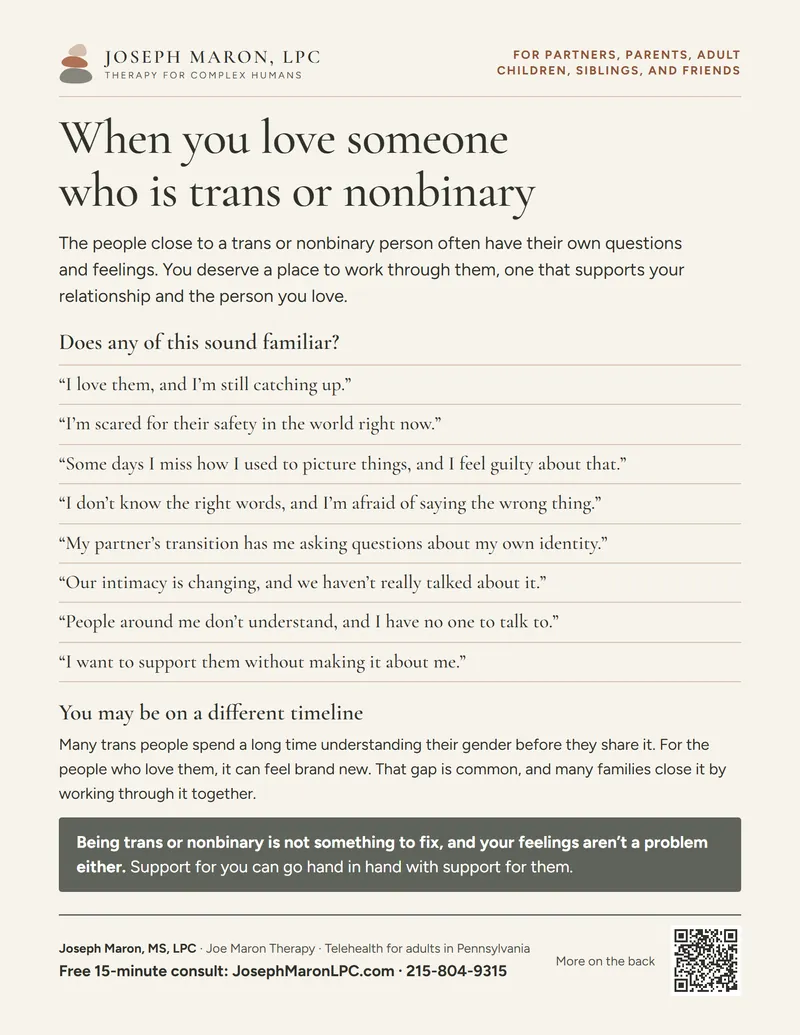
This is the printed handout, word for word. Print or download it at the end of the page.
Does any of this sound familiar?
- “I love them, and I’m still catching up.”
- “I’m scared for their safety in the world right now.”
- “Some days I miss how I used to picture things, and I feel guilty about that.”
- “I don’t know the right words, and I’m afraid of saying the wrong thing.”
- “My partner’s transition has me asking questions about my own identity.”
- “Our intimacy is changing, and we haven’t really talked about it.”
- “People around me don’t understand, and I have no one to talk to.”
- “I want to support them without making it about me.”
You may be on a different timeline
Many trans people spend a long time understanding their gender before they share it. For the people who love them, it can feel brand new. That gap is common, and many families close it by working through it together.
How therapy can help you, and your relationship
Feelings
Make room for what you feel
Sort through worry, confusion, or guilt in your own space, and make sense of what is changing and what isn’t.
Words
Learn the language
Get accurate information and practice the names, pronouns, and words that show respect, including how to recover when you slip.
For partners
Closeness and identity
Talk through changes in closeness, desire, or your own identity, at your own pace and without judgment.
Connection
Stay close
Practice listening and open conversation, and decide what kind of support you want to be. They can join some sessions if you both want.
What this therapy is
Individual talk therapy for you, by telehealth. For partners, it can include sex therapy: talk therapy about sexuality and intimacy, with no sexual contact, physical touch, or exam.
Support for them matters too
Working with me doesn’t replace support for the trans or nonbinary person in your life. I support you, and I affirm your loved one’s identity. With your permission, I coordinate with others involved in care. Peer support groups can help too.
On this site
Outside organizations
Getting started
Request a free 15-minute consult at JosephMaronLPC.com or call 215-804-9315.
Telehealth for adults in Pennsylvania. Private pay; superbills provided for out-of-network reimbursement.
I’m Joseph Maron, MS, LPC. I work with adult partners and family members, including parents of trans teens. I see the parent, not the teen.
Joe Maron Therapy · PA License PC017785 · Doctoral student in human sexuality, Widener University · Certificate in Affirmative Therapy for Transgender Communities · ADHD-CCSP · LGBTQ+ affirming care